Buying your first home can feel overwhelming – especially when you start hearing terms like stress test, GDS, TDS, mortgage insurance and qualifying rate. 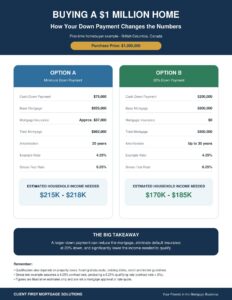
The good news? You don’t need to understand everything before getting started. Here are the key things first-time homebuyers in Canada should know in 2026.
1. How Much Down Payment Do You Need?
The minimum down payment depends on the purchase price:
- $500,000 or less: 5% of the purchase price.
- $500,000 to less than $1.5 million: 5% of the first $500,000 plus 10% of the portion above $500,000
- $1.5 million or more: Minimum 20% down Payment
For example, on a $1,000,000 home, the minimum down payment is:
5% of the first $500,000 = $25,000
10% of the remaining $500,000 = $50,000
Minimum Down Payment: $75,000
If your down payment is less than 20%, mortgage default insurance will generally be required. The insurance protects the lender – not the homeowner – but allows qualified buyers to purchase with a smaller down payment.
2. Income Matters – but So Do Your Debts
One of the biggest misconceptions among first-time buyers is that mortgage qualification is based entirely on income.
Lenders also look closely at how much of your income is already committed to housing and other debts. Two important calculations are used:
GDS – Gross Debt Service Ratio
As a general guideline, your housing expenses should not exceed approximately 39% of your gross household income.
Housing expenses typically include:
- Mortgage principal and interest
- Property taxes
- Heating costs
- 50% of applicable strata/condo fees
TDS – Total Debt Service Ratio
Your total monthly debt obligations generally shouldn’t exceed approximately 44% of your gross household income.
This includes your housing expenses plus debts such as:
- Car loans and leases
- Credit card payments
- Lines of Credit
- Student Loans
- other monthly debt obligations
These ratios are common guidelines, but actual lender and mortgage-insurer requirements can vary.
3. You Still Have to Pass the Mortgage Stress Test
Getting a mortgage rate of 4% or 5% doesn’t necessarily mean that’s the rate lenders will use to determine how much you can borrow.
Under Canada’s mortgage stress test, borrowers generally need to qualify at the greater of:
Your mortgage contract rate + 2%
OR
5.25%
For example, if your mortgage rate were 4.25%, you would generally have to demonstrate that you could afford the mortgage using a qualifying rate of 6.25%.
This can significantly affect how much home you can afford.
4. Credit History Is Important
You don’t need perfect credit to buy a home, but lenders want to see that you’ve managed your credit responsibly.
Before buying, try to:
- Pay bills and credit cards on time
- Keep credit card balances relatively low
- Avoid taking on unnecessary new debt
- Avoid financing a vehicle immediately before applying for a mortgage
- Review your credit report for errors
Even a new car payment can substantially reduce the mortgage amount you qualify for.
5. You Need to Prove Your Income
Lenders need to verify that your income is stable and sustainable.
Depending on how you earn your income, you may be asked for documents such as:
- Recent pay stubs
- Employment letter
- T4s
- Notices of Assessment
- T1 Generals
- Business financial statements if self-employed
- Bank statements or investment statements confirming your down payment
Getting these documents organized early can make the mortgage process much easier.
What Income Do You Need to Buy a $1 Million Home?
This is one of the questions we hear regularly.
There isn’t one answer because qualification depends on your down payment, debts, property taxes, interest rate and amortization.
However, here’s a simplified example to demonstrate how dramatically the down payment can affect affordability.
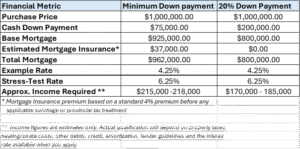
A Larger Down Payment Can Make A Big Difference
Notice the difference between putting $75,000 down and $200,000 down.
A larger down payment means a smaller mortgage, no mortgage default insurance at 20% down, lower monthly payments and potentially a significantly lower income requirement.
But don’t assume you need 20% before speaking with a mortgage broker. Waiting several years to save a larger down payment isn’t necessarily the best strategy for everyone.
First-Time Buyers Have Some Powerful Tools
There are also programs specifically designed to help Canadians purchase their first home.
First Home Savings Account (FHSA)
Eligible buyers can contribute up to $8,000 per year, subject to available participation room, with a $40,000 lifetime contribution limit.
Contributions are generally tax deductible, while qualifying withdrawals toward your first home are tax-free.
RRSP Home Buyers’ Plan
Eligible first-time buyers can currently withdraw up to $60,000 from an RRSP through the Home Buyers’ Plan.
Even better, eligible buyers can use the FHSA and Home Buyers’ Plan together toward the same purchase.
First-Time Home Buyers’ GST/HST Rebate
Buying a newly built home?
Eligible first-time buyers can now recover up to 100% of the GST or federal portion of HST, to a maximum of $50,000, on qualifying new homes valued up to $1 million.
The rebate is gradually reduced on qualifying homes between $1 million and $1.5 million.
Home Buyers’ Amount
Eligible first-time buyers may also qualify for the federal Home Buyers’ Amount, which can provide up to $1,500 in federal tax relief.
Don’t Forget About Closing Costs.
Your down Payment isn’t the only cash you’ll need.
Depending on where and what you’re buying, you may also need money for:
- Legal or notary fees
- Property transfer tax
- Home inspection
- Appraisal
- Property Tax Adjustments
- Moving expenses
- Strata document review
- Immediate repairs or improvements
Some first-time buyers may qualify for provincial exemptions or reductions, so its’ worth reviewing these costs before making an offer.
The Best First Step? Get Pre-Approved Before You Shop
One of the biggest mistakes first-time buyers make is falling in love with property, before determining what they can comfortably afford.
A mortgage pre-approval can help you understand: How much you may qualify for – how much down payment you’ll need – what your estimated payments will be – and what price range you should be shopping in
And remember: the maximum mortgage a lender will approve isn’t necessarily the maximum mortgage you should take.
Buying your first home is a major financial decision. A good mortgage strategy isn’t simply about getting approved – it’s about finding a mortgage and monthly payment that works comfortably within your overall financial plan.
At Client First Mortgage Solutions, we can walk you through the numbers before you start shopping, review available first-time buyer programs and help determine which lenders and mortgage options best fit your situation.